

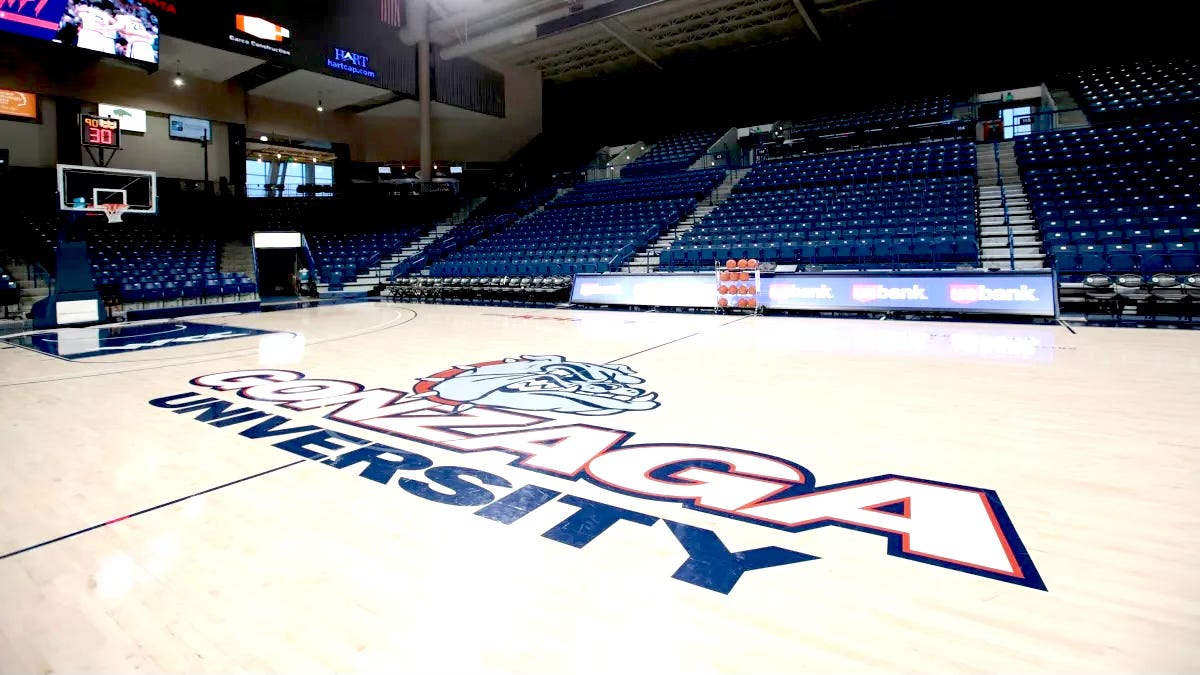
SPOKANE — The men’s basketball locker room at Gonzaga University was a raging mess on Monday morning. There were piles of sneakers and discarded socks spilled across the carpet. Granola bar wrappers and empty plastic bottles from protein drinks were scattered about the floor.
A line of black suitcases was parked near the door after the team’s return flight from Wichita. The Zags were eliminated from the NCAA Tournament in the second round by No. 1-seed Houston, 81-76, on Saturday. Gonzaga Athletic Director Chris Standiford must have expected the mess in the locker room.
“I don’t know what we’re going to find,” he warned me as we walked through the doors.
This is Part 2 of an ongoing series on the new-world Pac-12 Conference. Part 1 took readers to campus at Boise State. The project’s mission is to introduce Pac-12 fans to the newest members of the 110-year-old conference. Gonzaga will join the league on July 1, 2026.
What is the school about? What makes Gonzaga… Gonzaga? And how does the city of Spokane factor in its identity?
I spent a couple of days in the city in search of answers. I spoke with residents, visited businesses, and talked 1-on-1 with the Mayor. I toured the athletic department with Standiford, who grew up just a few miles away from campus. The AD attended Zags basketball games as as kid and played beneath the pull-out bleachers.
“Gonzaga is deeper than one or two people,” Standiford told me, “it’s a place.”
Gonzaga’s 152-acre campus sits a half-mile from downtown Spokane, bordered by residential neighborhoods. The Spokane River separates the campus from a sneaky good downtown corridor filled with restaurants, coffee shops, a mall, and a public library. A series of historic buildings have scaffolding blanketed around them, signaling a renovation.
The Mayor of Spokane is a 68-year-old woman named Lisa Brown. She moved here in her 20s from Colorado “along with a boyfriend,” she said. Brown got a job as a college professor, broke up with that boyfriend, and a few college teaching stops later, found her career in legislation and politics.
Brown described her city of 230,000 people as a “blue island in a red state.” The three biggest issues on her desk, the mayor told me, are: “Housing, housing, and housing.” During the pandemic, the Spokane housing market got tight as people from bigger cities moved in, took advantage of affordable living, and worked from home.
“Our vacancy rate dropped like a rock,” she said.
The mayor is married and has a grown-up son who plays in a Grateful Dead tribute band. The late Bill Walton would have loved that. The band calls itself “Spokane is Dead” but the city is very much alive, particularly as a college town. It has 29 distinct neighborhoods and four university campuses within 80 miles.
“Gonzaga is a huge deal in Spokane,” the mayor told me.
How big are the Zags here?
I asked Mayor Brown if she and Mark Few both walked into a restaurant and there was only one table available, who would get it? The mayor? Or the men’s basketball coach with two Final Four appearances?
“Mark Few is a celebrity,” she said, “let’s just put it that way.”


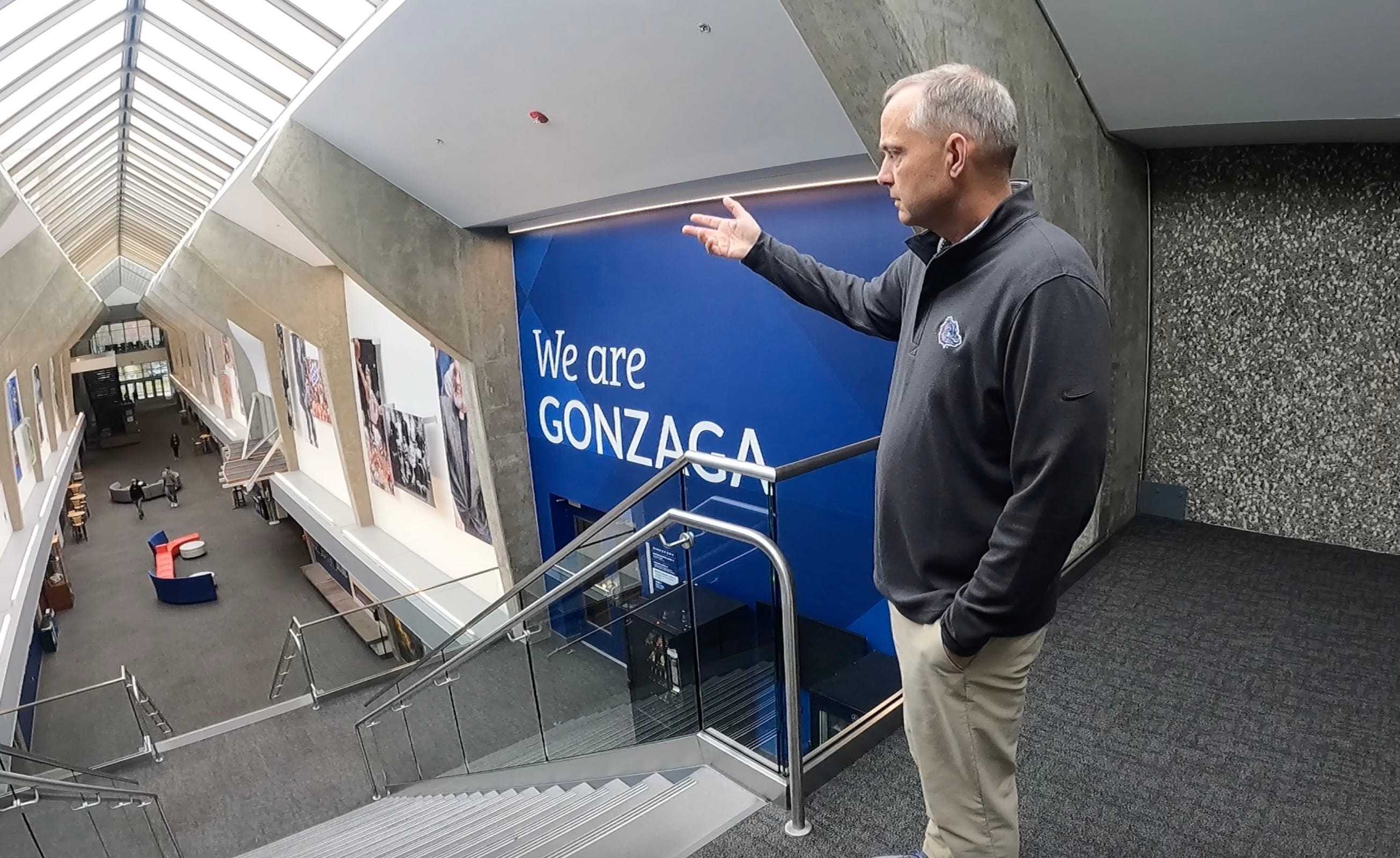
Few’s success is evident on campus at Gonzaga. The long halls of the basketball facility are covered with reminders of the program’s NCAA Tournament success, and the alumni who went on to play in the NBA.
Standiford gave me a walking tour on Monday. One of the first stops was the old campus gymnasium, the 3,800-seat Martin Center, often referred to as “The Old Kennel,” or the gym where John Stockton once played games.
“It belongs to the volleyball team now,” Standiford said.
McCarthey Athletic Center is “The New Kennel.” It has 6,000 seats. Season tickets for men’s basketball are sold out. There’s a waitlist, too. The school’s basketball practice facility features a weight room, training facilities, meeting rooms, and several courts. The lighting and hardwood surface precisely match the conditions inside the neighboring home arena.
Standiford was intentional about showing me Gonzaga’s “other” sports on the tour. We slipped inside the rowing team’s training facility. It’s a massive operation with rows of machinery. After basketball, rowing is the next biggest sport in Gonzaga’s athletic department.
We visited the baseball complex and the weight-training facility and toured the athletic department’s academic support wing, too. Gonzaga wants outsiders to know that it’s more than a basketball school.
Standiford stopped and pointed to a banner hanging high on the wall in the lobby of the athletic department. It commemorates the school’s 1950 national championship in boxing, a sport the NCAA has discontinued.
“It’s the only NCAA championship Gonzaga has ever won,” he said.
The new world Pac-12 had a problem with the narrative last September. It added five schools from the Mountain West Conference, then pivoted toward the top-tier members of the American Athletic Conference. It ran into some speed bumps and lost control of the messaging.
Term sheets with potential media distributions were presented to Memphis and Tulane. Plan 1A, sources told me, was to open a conversation with those two AAC schools. The Pac-12 and its consultants expected a negotiation. Instead, the schools surprised everyone by glancing at the terms and then almost immediately announcing they were staying put. Memphis and Tulane issued a joint statement with the rest of their league.
“We became plan 1B,” Standiford told me on Monday.
Gonzaga was aware of its value, particularly when it came to basketball media rights and branding. One of the school’s boosters bankrolled the hiring of a high-profile consulting firm. The school engaged in exploratory conversations with other conferences, including the Big 12, in the last few years. But an offer never materialized.
Few told me last October that there were “a few things discussed over the years that the media wasn’t up to speed on.” Among them was a serious flirtation with the Pac-12 and former Commissioner George Kliavkoff before his conference imploded.
The landscape of college athletics was shifting.
Gonzaga was growing restless.
The university needed a conference willing to make a big bet on basketball. It needed a league that valued the brand boost Gonzaga could offer. Pac-12 Commissioner Teresa Gould flew to Spokane a day after that Memphis-Tulane overture unraveled and made her league’s pitch to the Zags in person.
Gould’s approach resonated with campus leaders, including Standiford, Few, and Thayne McCulloh, the university president. That trio has more than 60 years of combined tenure. Spokane — and the campus at Gonzaga — Gould must have picked up, are handshake and ‘look-you-in-the-eye’ places.
She did both of those things well.
Stu Jackson, the WCC commissioner, wasn’t blindsided by any of this. I find that interesting. Gonzaga kept Jackson informed. It helps explain why there aren’t more bad feelings. Jackson told me that McCulloh called him at 10 p.m. the night before Gonzaga made the Pac-12 announcement. It was a move, the president told the commissioner, the school needed to make.
“It happened very, very quickly,” Standiford told me. “We’d done all the analysis. We knew the valuations. We knew what the market said about us. For Gonzaga, it was a big deal to move beyond the private catholic, colloquial, West Coast Conference university to something else.”
For the Pac-12, getting Gonzaga changed the narrative overnight.


People in Spokane will tell you that the city has four distinct seasons. They’ll direct you to stay at the historic Davenport Hotel and dine at fun downtown restaurants — places such as Wooden City (order the spicy rigatoni) and Anthony’s (clam chowder or seafood).
I asked the mayor how she pitches Spokane to friends living in other states.
“I tell them I love the fall,” she said. “I ski in the winter and go to the lake in the summer. It’s not a rainy place, either. People know Seattle and Portland for being on the rainy side.”
Standiford described the late spring and early summer in Spokane as: “Hot days, cool nights, and beautiful colors.”
The visitor’s bureau should put that on a billboard along with a picture of Spokane Falls. Although, when you consider the housing crisis, maybe it’s best to leave those sales pitches tucked away.
Gonzaga is an integral part of the experience in Spokane. That’s evident when you talk with fans who think the Pac-12 is going to be a terrific basketball league. Seeing a men’s or women’s basketball game at “The Kennel” is a bucket-list activity.
The Pac-12 still needs to add at least one more school that plays all sports, including football, before July 1, 2026. The conference is also knee-deep in a media rights negotiation. Those things are waiting for resolution.
Gonzaga will join as a full media share member of the Pac-12 in 2026. The Zags will receive a 100-percent share of the conference’s TV deal. The school won’t pay football-related expenses. Nor will it receive a share of potential postseason football revenues, per sources.
Standiford told me Gonzaga is focused on the basketball element of the Pac-12 TV deal featuring “the right partner.” He isn’t caught up on the bottom-line media dollars as much as healthy exposure and a network interested in growing the product.
“We’re looking for a true partnership,” he said.
Getting Boise State football was the first crown jewel for the Pac12. Getting Gonzaga for MBB was the second. It's all coming together for the Pac12. Looking forward to part 3.
John, thanks for expanding your scope for part 2 of this series. Part one was very campus-centric, exploring what joining the Pac-12 meant to Boise State University, but not the city at large. In part 2, you expanded the parameters a bit by talking with the mayor. But what's still missing, in my opinion, is the point of view of the guy in the bar stool, the season ticket-holder, the long-term Spokane resident. How do the FANS feel about moving to the Pac-12? What are they excited about? What are their expectations, or fears? Am I the only one that cares about more than what the university or politicians think?