

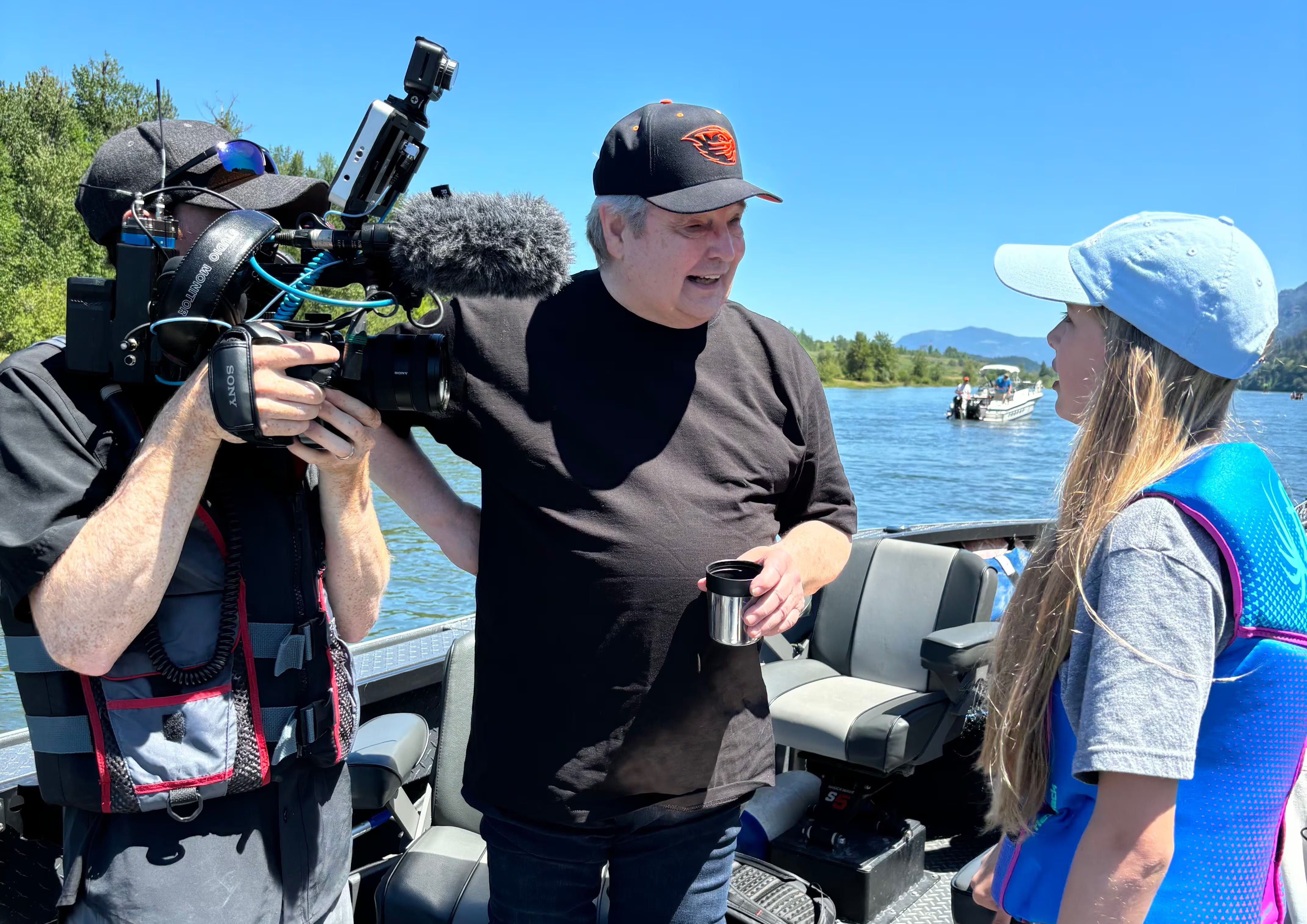
Grant McOmie invited me to go fishing on a Friday morning last football season. I couldn’t make it. He and Bill Monroe, the most prolific outdoor writer the Pacific Northwest has ever seen, were fishing for salmon in the Columbia River.
I’m kicking myself for being busy.
McOmie, who spent 50 years reporting about the outdoors on two local television stations, went to the hospital last week with blood clots. Doctors discovered an undetected cancer. He didn’t have much time.
“A day or two left,” a message came.
Grant McOmie died on Thursday, surrounded by his family.
He was 73.
McOmie had a folksy delivery and a box of gravel for a voice. He was well-sourced and knew all kinds of interesting things about the world. He was curious, smart, and tactful. Viewers of KGW and KATU were lucky to have him out there, poking around the woods and wading into rivers.
His “Grant’s Getaways” TV installments were rich and alive. They reminded people to get outside, pick things up, examine them, climb, hike, fish, hunt, and never stop moving. I went on a fishing expedition with McOmie years ago in the Willamette River. I caught a Steelhead and dozens of epic stories that morning.
When McOmie asked me to go again in early September, I couldn’t make it. I had a plane to catch. I was waist-deep in the first month of college football season. I’ve wondered what I missed out on. So I called up Monroe on Saturday morning.
“How are you doing?” I asked him.
“I’m alert,” Monroe said. “Why, what have you heard?”
For the next 20 minutes, he talked about his old friend, Grant McOmie. Turns out, they caught a 22-pound Chinook salmon that day. They told stories, had countless laughs, and discussed what caused a prolific salmon season.
Monroe served in the U.S. Navy and traveled the world. He has a stack of outdoor-writing awards and stories for days. McOmie studied Drama and English as an undergraduate in college. Then, he pursued graduate studies in Journalism, English, and Speech. He later took a job as an adjunct professor at his alma mater.
When you climb out of a boat after spending a few hours with those two, someone should hand you a diploma.
“Grant understood the magic of the Pacific Northwest,” Monroe told me. “I’ve been to a lot of places in this world. Nothing compares with the versatility of the Pacific Northwest. Grant tried to remind people to try harder to take care of that. He didn’t preach. He didn’t have to. His congregation was the outdoors.”
McOmie met his wife, Chris, when they were students at Pacific University. They fell in love and made a life. They have three sons and a line of grandchildren.
“Grantlings,” he liked to call them.


There’s a whole self-help business written about the power of now. Stay in the moment. Be where your feet are. Take care of the 20 square feet around you. All that. We’re told not to waste our time with worry, regret, anger, or holding a grudge. But I sure wish I’d gone fishing that day.
Turns out, it was my last chance.
“The weather was beautiful,” Monroe reported. “Lots of happy customers on the boat. That was a fun day.”
When I arrived in Oregon to cover sports in 2002, I was struck by the pairing of Monroe and McOmie. They were the two main journalists who covered the outdoors. In another media market, they might have fashioned themselves as fierce competitors. But they recognized they were in the same business — educating the rest of us. They carved out turf, encouraged other outdoor journalists, often worked in concert with each other, and became close friends.
Monroe’s writings remain wildly popular and highly entertaining. He’s a deft wordsmith prone to showing up in the office wearing rubber galoshes. McOmie had the region’s TV world covered with his cult-like following. He was worldly and interesting. I understand why they got along so well. Had they come up in a different era, they’d have been a successful reality television show.
McOmie and Monroe were — out there — in the world, operating as a force. They’ve been a five-decade-long gift to the region. I fashion them in my mind as if they’re some kind of modern-day Lewis and Clark. McOmie and Monroe were on the adventure, reporting what they saw, urging the rest of us to open our eyes, get outside, and see the magnificence out there.
On Saturday, at the end of our phone call, Monroe said something I’ll never forget. He brought up the journal entries of Meriwether Lewis. The explorer had documented his travels, writing about the cultures, the beauty, the danger, the constellations, and the landscape of the world around him.
There was a phrase Lewis liked to finish his entries with, Monroe told me.
He said it before he hung up.
“We proceeded on.”
A folksy delivery and a box of gravel.
What great words.
Grant McOmie was a legend.
I worked at KATU for 20 years lugging a camera, shooting news and sports. Shoots with Grant were always an education. They were also a joy, wonder and work! Whether drift boating on a snowy Wilson river or tracking bears with scientist with radios, up and down the steep old growth forests of Lane county, it was always worth the effort. Thanks for this loving tribute to Grant and Bill. We don’t know how lucky we have been to have these men share their lives and stories.