

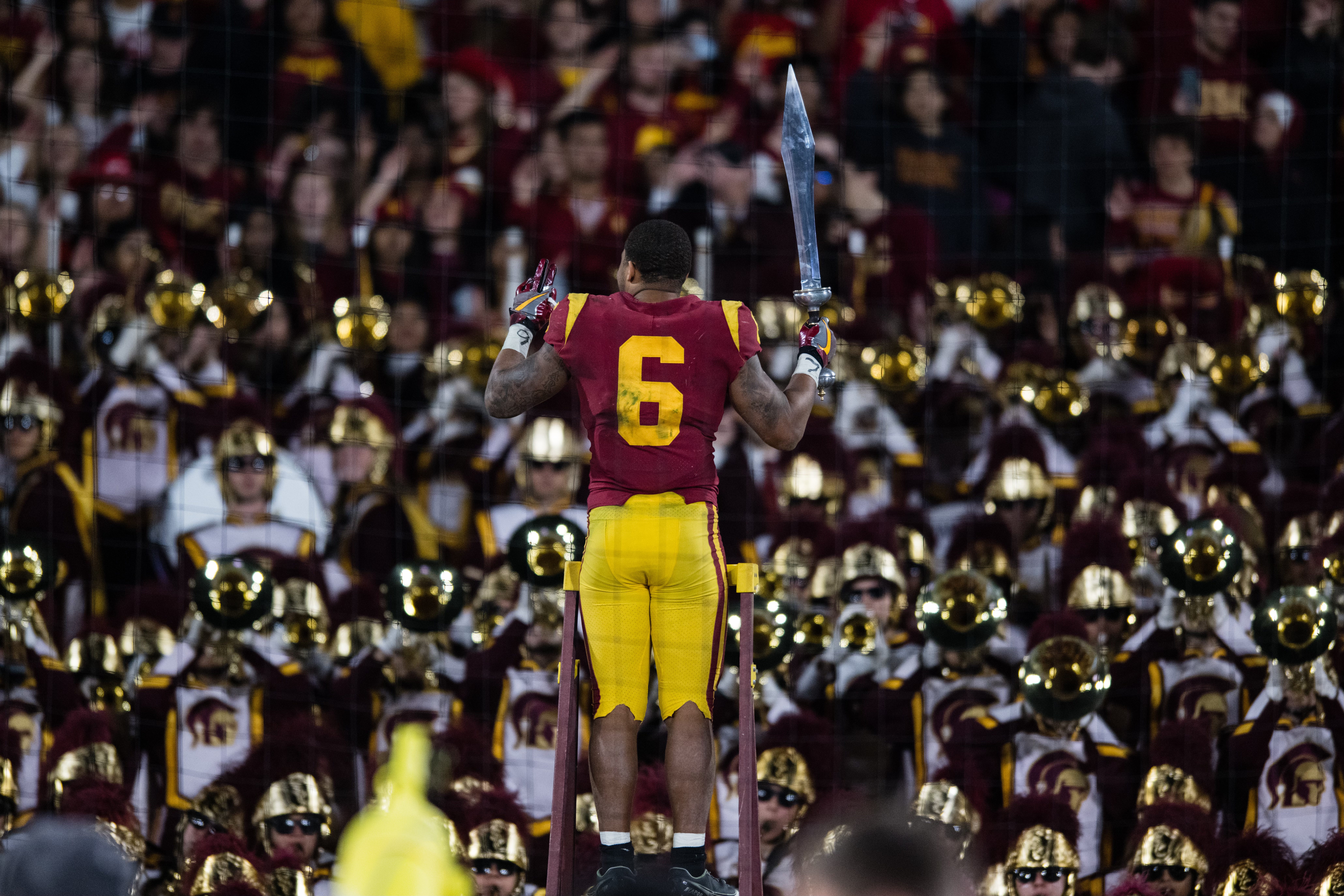
I received a note from a discouraged reader this week. He told me he was done with college athletics. For the umpteenth time in the last year, a die-hard fan told me he was ready to throw in the keys.
Wrote Andy: “It has been disheartening to watch the core of what made college football great erode over the past few years.”
There was one distinct difference between this note and the dozens of others. It was not sent to me by an alum of Oregon State or Washington State, beaten down after being squeezed out of a power conference.
It wasn’t from a Stanford or Cal fan, saddened by the absurdity of those schools being in the ACC. It wasn’t written by a loyalist who donates to a marginalized program.
This note came from a USC fan.
He’s hollowed out, too.
“The sport is now NFL lite,” Andy wrote.
It’s Christmas Eve. One of my daughters woke me this morning to inform me that she’s beyond excited about what will go down in the next 24 hours. There was hope and electricity in her voice.
Anticipation is an important thing. It’s like Lucy Maud Montgomery wrote in Anne of Green Gables, the children’s novel from the early 1900s, “Looking forward to things is half the pleasure of them.”
I grew up feeling that way about sports. When I was 10, Kodak made a poster commemorating that season’s Kodak All-American football team. I sent away for it and hung it on the wall of my bedroom.
I studied the faces of North Carolina’s Lawrence Taylor and Georgia’s Hershel Walker. I noted that BYU’s Jim McMahon and Baylor’s Mike Singletary both wore eyeglasses. But it was the Pac-10 players that I was especially interested in.
A pair of hard-hitting safeties, Ronnie Lott from USC, and Ken Easley of UCLA, were on that poster. So was Stanford receiver Ken Margerum, John Elway’s favorite college target. I grew up on the West Coast, and I’d seen the Pac-10 on Saturdays on ABC with Keith Jackson calling the games. Those were my guys.
Do we think that way anymore?
USC and Notre Dame are ending a football rivalry that dates back to 1926. They were in talks about a two-game extension that would have prolonged the football series that once traveled by train. The discussions broke down. Blame USC coach Lincoln Riley, who ran from a challenge. Blame the Irish, who look like cowards.
Neither school put an eight-decade tradition in front of the current fear that playing a tough non-conference game might cost them a chance to get in the College Football Playoff and make millions.
It’s a business, they’ll say.
I understand the economics of college athletics. I’ve written about the growing influence of TV. I’m tuned into media-rights negotiations and sensitive to the balancing act that campus administrators face in allocating resources.
I specialize in palace intrigue in this column. I love nothing more than lifting back the curtain and showing the hysterics and absurdity going on internally. Amid that quest, I’ve been increasingly concerned about the general health of the ecosystem.
The palace is burning.
I recently had an interesting conversation with my 11-year-old daughter. I’m certain she’s going to be a scientist of some kind when she grows up. One of her middle-school teachers has her thinking about the Industrial Revolution.
The world saw incredible advances during that period. Machines started doing work. Factories became a booming business. Efficient, stable manufacturing skyrocketed. Technology and innovation spiked. Economies exploded. Capitalist societies rose to power. It might be the most important development in modern human history.
It wasn’t all great, though.
Natural resources were exploited. Fossil-fuel pollution became a thing. We struck alarming highs with toxic emissions and environmental destruction, and working conditions for some were deplorable.
We made steel at a record pace. The engines of industry were roaring. But also, child labor exploitation became a thing, people worked themselves to death for low wages, craftsmen lost their jobs, family culture shifted, and deforestation happened.
Advances can be beneficial. Change is inevitable. But man, someone has to be mindful of the consequences of going full-throttle into the unknown lest the entire ecosystem get sucked down by greed. We know that. They’re teaching it to sixth graders.
Anyone following college athletics knew that the NCAA was in deep denial for decades over sharing revenue with athletes. It kept punting the problem down the road instead of offering a proactive revenue-sharing model that would have avoided the current free-for-all mess.
College athletics used to have guardrails and rules. It was an orderly place that was probably overdue for a little excitement and change. But it has now swung to the other extreme. It’s turned into a three-day weekend in Amsterdam.
The conferences are recklessly chasing new revenue streams. Amid that, TV partners and billionaire boosters have grown increasingly influential. The university presidents handed the power to conference commissioners, who handed control to TV networks. I don’t blame television for doing what is best for itself. That’s a real business. I blame the leaders in higher education for forgetting their mission and turning into campus pimps.
Conferences consolidated.
Traditions got trampled.
The games themselves are still thrilling and interesting, but the casualties are piling up. This USC-Notre Dame rivalry is toast. It’s the latest collateral damage.
“The enormous hypocrisy of college athletics is too much to bear,” University of Michigan Regent Jordan Acker told me in a 1-on-1 talk two years ago.
Again, one of the dissenting voices was coming from a traditional “have” in the college world. It was unusual. This wasn’t the president at Akron, bellyaching. This was a regent of a traditional powerhouse program who was pulling the fire alarm.
“You’re not student athletes,” Acker told me. “Going from Ann Arbor to Eugene, Oregon, is not the behavior of a student-athlete. It’s the behavior of an employee. We have to be serious and realistic about what we’re dealing with here, and it’s not amateurism.”
Nick Saban ran for the hills.
Alabama’s coach wasn’t just tired and aging. He was tuned in and aware. He’d benefitted immensely from a tilted playing field. The game wasn’t just changing. The game board itself was about to be tossed on the ground, scattering the pieces. There was a lot of unknown. Saban got out while he still had advantages. He didn’t go home to play golf. He just turned into a talking head on TV.
Again, it’s Christmas Eve.
It’s a time for reflection and family. It’s a hopeful night. One laced with tradition and anticipation. I’m left thinking about college football and hoping that the tumultuous feel of the last couple of years dissipates and the sport soon pulls itself back together.
Presents on Christmas Eve or Christmas Morning? What’s on the table for the holiday dinner? A star or an angel on the top of your tree?
Family coming over?
What else?
Traditions matter. USC and Notre Dame both know that. I covered the Irish years ago as a beat reporter. That entity celebrates its deep and rich history. USC does the same. Those schools didn’t suddenly forget that traditions were important; they just decided to ignore it.
I don’t blame the Trojan fan for being despondent. He got dragged into the Big Ten by a greed-stricken university. His school isn’t positioned as an upper-tier program in that conference. Now, it’s no longer scheduling Notre Dame.
Andy, the frustrated USC fan who wrote, engaged in a brief back-and-forth with me. I suspect many of you will vent your frustrations and provide thoughts in the comment section. Andy told me he’s turned off by college football. But he’s continuing to read this column, in part, because it dives beyond the games.
I prefer a deep dig.
I love human interest stories, too.
There’s much more to all of this for me than the box scores and standings.
Fans are frustrated. The proponents of the sport keep holding up strong TV ratings as evidence of health. I don’t know about you, but when I see a burning Winnebago parked on the side of the freeway, engulfed in flames, I’m like everyone else. I slow down. I take a good, long look.
My eyes don’t see a healthy college football system. I see schools in a scramble to keep up. I see coaches on fumes. The race for resources is mind-numbing. I see players jumping in the portal thinking they’re going to be rich, woefully unaware that they’re about to end their careers.
Conferences are kicking the tires on private capital.
Universities are jumping in the water with the private-equity sharks.
Fans are sticking with it, for now, enjoying the football, but man, I love it when people don’t sit quietly. I like that there’s a faction of fans out there who are screaming from the tops of their lungs that something is wrong.
I suspect they’re in the majority.
They should keep speaking out.
That’s a hopeful thought.
Please consider a gift subscription for a friend or family member as a Christmas gift, or consider donating a subscription to a senior citizen on a fixed budget below:
As a WSU alum, I certainly don’t feel bad for the USC fan. He might not have pulled the trigger himself, but their fans have been quick to kick us to the curb without a second thought just like their university administration did.
Fortunately, I got to watch a bowl game a couple days ago that screamed brotherhood. Of course, now the screams are quickly turning to “show me the money”.
This article explains why I was so tuned into Montana/Montana State over the weekend. The other games felt boring by comparison. And I think it’s safe to say that “The Brawl of the Wild” has become a better rivalry than both the Civil War and Apple Cup in a span of less than two years, all because of the actions of the ADs at Oregon and UDub.