

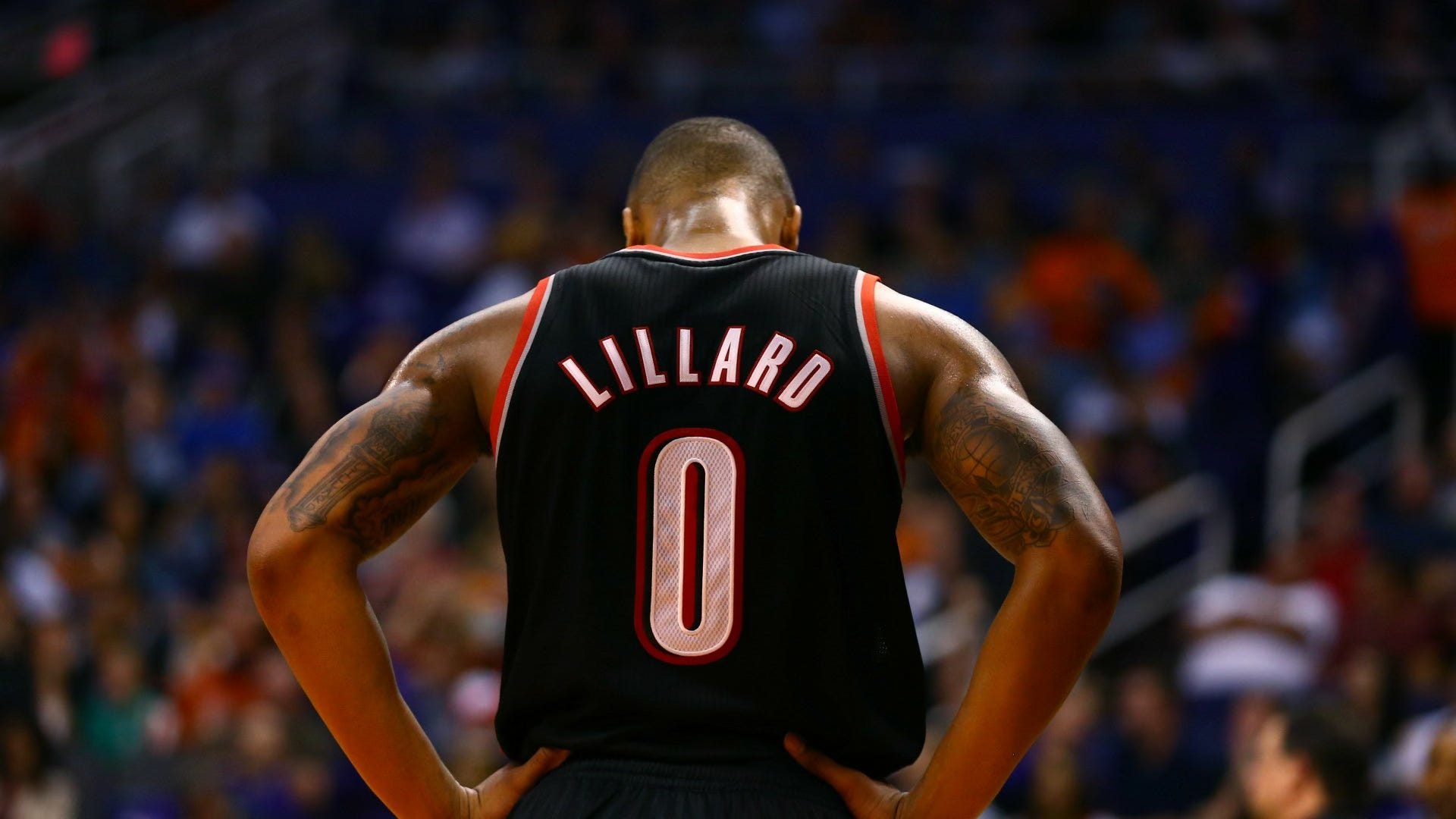
The Trail Blazers paid Donna Millak $1.65 an hour in the early 1970s. Her job was to sew the names and numbers on the NBA team’s jerseys.
One stitch at a time.
One story at a time.
Millak and I crossed paths more than a dozen years ago. I hadn’t really thought much about it until then, but obviously someone had to do the jersey stitching. And I met with the red-haired woman, full of life, who did the team’s sewing over the years.
Millak died on Friday.
She was 83.
Donna told the best stories. She shared all sorts of interesting things with me. Did you know the Blazers recycled their jerseys for a while? It’s true. As late as the mid-1980s, Donna would remove a player’s name and number when they left the team and sew on ones for a newcomer.
“The franchise didn’t have the money it has now,” Millak told me before the 2014 playoffs. “We did that a lot. Kenny Carr says to me once, ‘I’m superstitious. Please tell me that you’ve never done that with my jersey.’
“I assured him we never had.”
Little did he know.
Players in the 1970s and 1980s were fitted for their uniforms in person. Donna would receive the names, numbers, and sizes. Bill Walton’s jersey was enormous, she told me. And for the final fitting, Donna would often go to the locker room at Memorial Coliseum, and the players would try them on.
“I hated being in the locker room,” she told me all those years ago. “Half the time I was in the shower area. A couple of the guys were so shy, and I was, too; I just kept looking at the floor. This was long before women were anywhere in the locker room. I remember one of the players in the late 1970s saw me in there and said, ‘What’s she doing in here?’”
Former No. 1 overall draft pick Mychal Thompson heard this and announced, “She’s a married lady, guys. She’s seen everything in here, guys, it’s no big deal.”
After that season, the players decided to come to her shop.
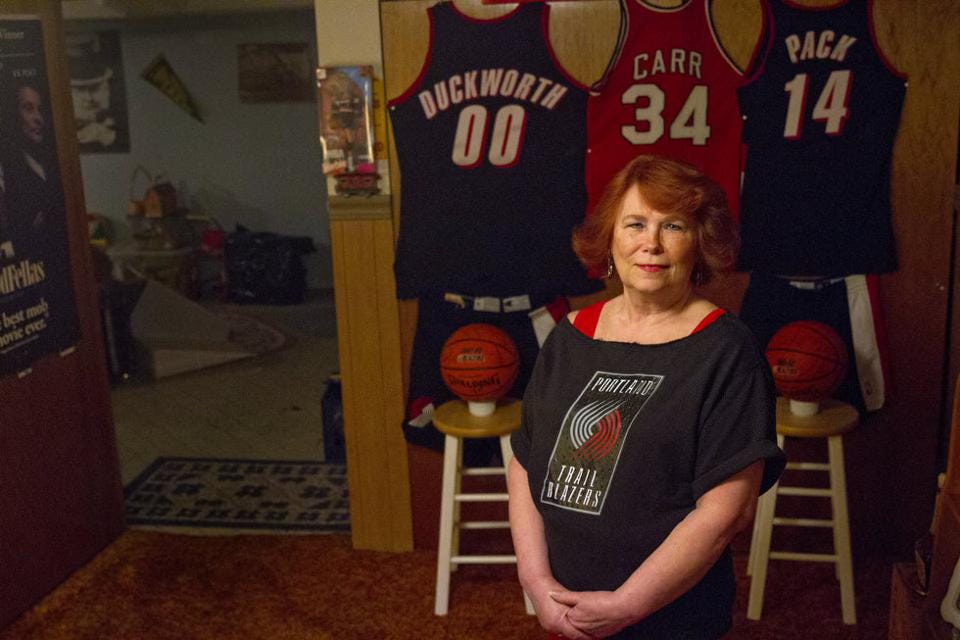
Donna beat a battle with cancer. She lost her oldest son in a car accident. The Blazers gig was a part-time thing. The company she worked for as a full time seamstress was bought and sold several times.
She kept stitching through it all.
Donna lost sleep when the Blazers drafted Petur Gudmundsson in the third round of the 1981 draft. The Icelandic center’s last name G-U-D-M-U-N-D-S-S-O-N was a nightmare.
“I could hardly get that name on the shirt,” she told me. “I had to arch it steep.”
Gudmundsson was traded after two seasons.
Donna didn’t mind.
“I prefer names with five or six letters,” she told me. “When you have a B-L-A-K-E or B-A-T-U-M, you have something you can really work with.”
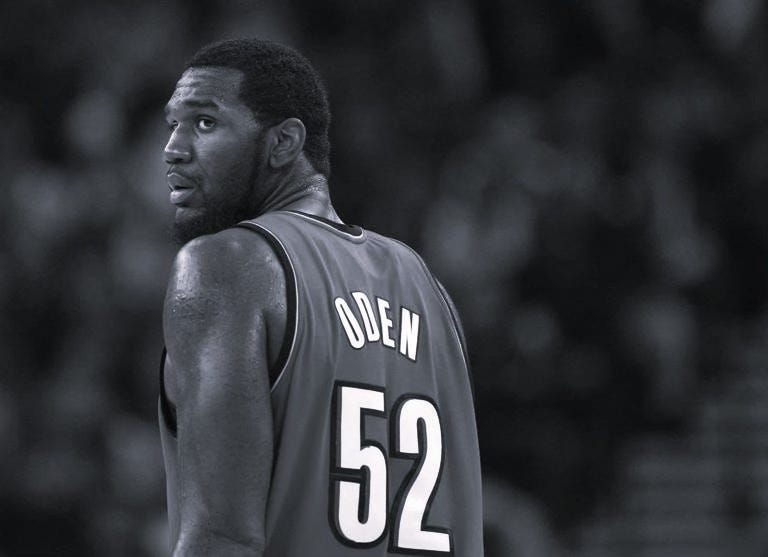
Donna confessed to me once that she didn’t love putting “ROY” and “ODEN” on a jersey, either. The names were too short. Donna told me she struggled to arch the names in a way that looked pleasing to her eye.
Creating the jerseys was painstaking and meticulous. In the early years, Donna had to cut out all the numerals and letters for the fronts and backs. Later, the job got easier. The lettering and numbers started arriving pre-cut. Late in her career, Millak told me she could finish a jersey in six minutes if she needed to be fast.
The Blazers’ equipment manager frequently summoned Millak over the years on short notice, asking her to produce one of her jerseys for a player they acquired only hours earlier. Those players never met the seamstress who worked through the night, but arrived in Portland to find their jersey hanging in the locker.
On other occasions, visiting NBA teams have shown up with a blank jersey and a helpless look, asking if Millak would mind sewing one for them before tip.
“It was a labor-intensive art," she told me.
Donna howled with laughter, telling me about the uniform fittings that involved Darnell Valentine, who played for the team from 1981-86. He always wanted alterations to his shorts.
“Oh my God, he loved his legs,” she told me. “I had to shorten his shorts every year. He’d say, ‘I have beautiful legs. I can’t hide these things.’
“So I’d shorten the shorts, and he’d try them on and have to go find a mirror in the back of the shop because I didn’t have one at my station. Darnell would parade around the shop in those shorts until we got it right.”
She had her favorite players, just like you. Maurice Lucas, of course. Also, Kevin Duckworth, Damian Lillard, and Meyers Leonard. And she told me that the only jersey she ever made for herself was Brian Grant.
“It took me a month to make from scratch,” she said.
When Duckworth collapsed from heart failure in his hotel room along the Oregon coast in 2008, it was Donna who sewed a black stripe on the jerseys in his honor with tears in her eyes. After Lucas died after a long battle with bladder cancer in October 2010, Millak was called upon to sew a No. 20 patch on each jersey.
She told me: “It’s a lump in your throat kind of thing.”
Donna married a man named George. He died in June of 2021. When I met them, they’d been together 32 years and had six children between them. A seventh child, a 19-year-old son who was Donna’s oldest, died in a motorcycle accident in 1984.
She got a knock on the door at 4 a.m. Two police officers were standing there.
“It was not his time,” she told me.
Donna’s time came on Friday.
I was informed of the bad news by a patron of a restaurant that her daughter, Shelly, owns and operates. It’s a hop farm and brewery in Carlton called Root & Rye. I’ve never been to the place. But the customer told me that the column I wrote in the spring of 2014 about Donna is framed and hanging on the wall. I plan on going soon.
Shelly also owns the Old Market Pub and Brewery and the Broadway Grill and Brewery. Her mom was her biggest fan. They’d eat sometimes at one of the places and then go to a Blazers game.
“She was so proud of me,” Shelly said.
This independent endeavor aims to go where the best stories are. Donna is one of the good ones. I’ve made a point to steer my recent Sunday columns into the subject of human interest. It’s a break for us all from the conference realignment, free agency, and litigation.
We need uplifting stories. Donna’s life is a tale of perseverance, grit, verve, and joy. Her dedication to her craft was admirable. Her attention to detail was impressive. It’s a reminder that the little things matter. Also, that life isn’t that much different than a sewing needle. In fact, she told me exactly that once.
“Ups and downs,” she said.
NBA players come and go. Executives get hired and fired. Coaches stick around, but only for a while. After meeting Donna, I never looked past the jerseys. I never took the names and numbers for granted because I knew how much she cared about getting them exactly right. She stayed on the job until 2019.
When I look up at the retired jerseys hanging in the rafters at Moda Center, I don’t just see the Blazers’ greats up there. I see Millak’s work, too.
It was a thing of beauty.
Please consider a gift subscription for a friend or family member as a gift, or consider donating a subscription to a senior citizen on a fixed budget below:
Maybe I’m alone, but in 35 years as a Blazer fan I had no idea the jerseys were hand-stitched. I will never look at them the same. Donna, you were a legend! Thanks for these articles, John.
Another great one and as you say, Sunday is for heart warming stories not dealing with the chaos in college sports.
It reminded me of the minimum wage in 1971, $1.35/hr. I got a job cooking for the DQ at 122 st in park rose. The training wage was $1.25. She was a skilled seamstress and still wasn’t paid well by a professional team.