

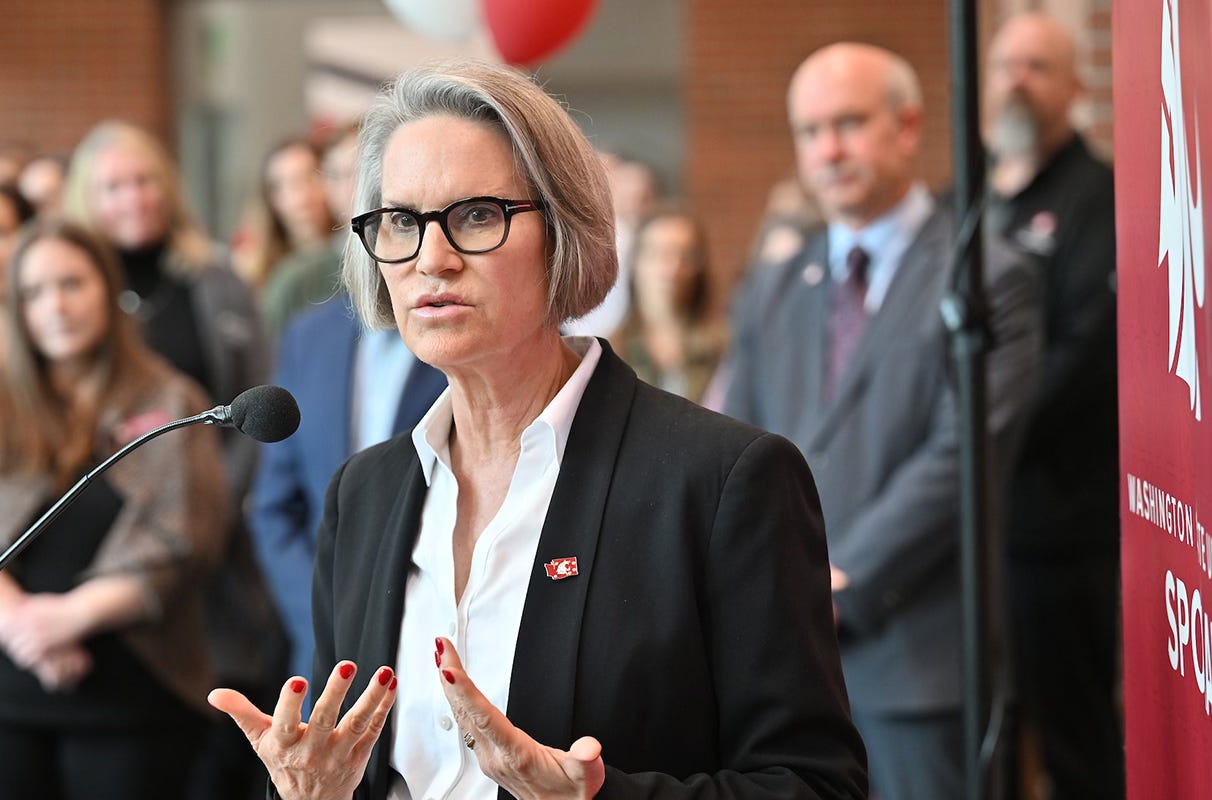
Washington State President Betsy Cantwell sat down for a 1-on-1 conversation with me about the Pac-12’s ongoing rebuild, her university’s race for resources in athletics, and her vision for athletics in Pullman.
Cantwell told me the job of a campus president has changed in recent years
“I spend 50 percent of my mental time on athletics,” she said.
She talked candidly in a wide-ranging interview about a variety of subjects, including why she thinks football coach Kirby Moore is worth betting on.
An MBA from Wharton? A doctorate from Berkeley? Raising five children? A previous work-life spent in collaboration with NASA and the Department of Defense?
Cantwell’s life experiences play a fascinating role in the job in front of her. She refers to herself as “a proud geek” and says she aims to raise $20 million in new funds at WSU.
Cantwell shared her thoughts on the job security of Pac-12 Commissioner Teresa Gould and the exposure that comes with the conference’s new media deal. She also questioned why the western part of the United States got the short end of the stick in the last three years as college athletics shifted dramatically.
“Why has this entire narrative and this entire story over the last three years said, ‘Ignore the West Coast’? What is going on there? If I were a governor of any West Coast state — red or blue — I would be up in arms,” Cantwell told me. “That means whole economies that are being created on the East Coast are not being created on the West Coast.”
Listen to the interview via audio podcast or watch the video of our interview on YouTube:
Some snippets…
Cantwell on hiring football coach Kirby Moore:
“We did that really fast. And just kudos to everybody involved in that. It came down to three final candidates, and I got involved personally… I met one-on-one with all three final candidates. They were all exemplary, really amazing people, and would have been amazing coaches. But Kirby really stood out, not just because he’s a child of Eastern Washington, which really means a lot to people, but because he really has an amazing vision. And I think he was worth placing a bet on.”
On the fundraising mission at WSU:
“What happened to Washington State University after the Pac-12 fell apart was a sense of true grief. I mean, emotionally, it was community grief. And what we have emotionally now is community belief in the future. That new conference is not going to be the old conference at all. I know you know that more than anybody. There is a firm wall. But what it will be is a startup with all of the emotional value of being involved in a startup. If you wear crimson out there, you are a founder in this new conference.”
On strategy for the Pac-12 in the next four or five years:
“Let’s say the four-year time frame, when all the media rights deals all get (redone around the country)... They don’t really go up in smoke, but they might. I mean, we might see a whole other transformational moment to the one that we saw a year and a half ago, two years ago. So my goal is to position the conference and WSU as not the peak money generators, but the most interesting.”
On her view of Pac-12 Enterprises:
“You have to think of the Pac-12 as a startup. We’re a startup, we all have assets, though. We’ve got a beautiful stadium. We’ve got a beautiful basketball arena. We come to the table as a startup with assets. I think of the Pac-12 Enterprises as an asset that we use in the start-up sense to optimize both our capacity, and we may be able to drive some alternative revenue streams that other conferences don’t have the capacity to drive. That’s where I think we all think about Pac-12 Enterprises.”
On the potential expansion of the College Football Playoff:
“My bias at the moment, meaning my opinion without full data, is that a larger playoff component will be better for everybody. That’s my bias. Now, that’s probably not the bias of the folks who are making the most money now. And honestly, if I were one of them, that’s where I’d be. But I think for us, and especially just looking at the way that West Coast institutions are suffering, because even if you’re in one of those (Power Four) conferences, your student athletes are suffering long-distance travel repeatedly and constantly. So that’s my biased opinion at the moment. And let’s come back to this after, actually, after the championship game. There will be a couple of CFP meetings at that point… I think more would be better.”
On why nobody thinks about the ‘greater good’ in college athletics:
“The simple answer is money is an unbelievable driver, and there’s a lot of money to be made, and earned. And the truth is that there was a lot of money being earned, but it, for instance, wasn’t shared with student athletes. So now the deal-making picture is much more complex and interesting. And a lot of deal makers out there who are not in college athletics are jumping in because if you’re interested in deals, we’ve got the most interesting deal structures, the most interesting deals, really interesting landscape of deals.”
On what she reads and binge watches:
“I'm reading a book called ‘Dopamine Nation’ by a Stanford doctor named Anna Lembke… She’s an addiction specialist, but it’s really about how all of the technology we use, and actually just the world we live in, is becoming more and more about dopamine hits, which are a really short-term addiction cycle, if you will. And we’re losing the capacity for things like reading an entire long book like ‘War and Peace,’ which I am not reading. I’m reading ‘Dopamine Nation,’ and I’m giving it to people, including even my grandchildren. I think it’s a really important lesson for all of us who sit there doing this all the time because the dopamine is so strong… I’m an engineer and a scientist and a geek, and I just finished the last season of ‘Stranger Things,’ which I thought was really cool. And I’m watching ‘Pluribus’ also, which I highly recommend. If you’re a science fictiony person, it’s wacky.”
On Commissioner Teresa Gould’s contract:
“I can’t tell you much other than there is no intention other than to renew her contract. She is super important to us, and we will make sure she stays in place.”
On the exposure the conference gets in the Pac-12’s new media deal:
“We need to really make sure that we are positioned for what’s next, which means a lot of exposure. It doesn’t mean exposure at the expense of some revenue, but we’re under no illusion that we should be back in the old days of the Pac-12. I think that balance has been incredibly well-achieved at the moment. Exposure is really important. I think of us, honestly, I think of us as a Netflix documentary. And what’s compelling about Netflix documentaries? It’s partly the exposure to the thinking process and the exposure to the way that things that make people tick in the real world. And media exposure does that for us.”
Please consider a paid subscription for yourself. Or a gift subscription for a friend or family member, or the donation of a paid subscription to a senior on a fixed budget:
Too bad her and more common-sense Pac 12 college Presidents weren't around 5 years ago.
Wazzu is in good hands. Go Cougs!